
Porn Sites not Blocked by Opendns - Parents Should Know
Keep kids away from unblocked porn sites
ALL TOPICS
- Ways to Block Porn
- Block Porn Sites
- Block Porn Tips

Sep 22, 2026 Filed to: Block Porn Proven solutions
Parents searching for porn sites not blocked by OpenDNS, unblocked porn, or porn not blocked are usually dealing with the same problem: adult content is still reachable even though a DNS filter is supposed to be active.
OpenDNS has not stopped offering parental filtering. In 2026, OpenDNS FamilyShield is still preconfigured to block adult content, while OpenDNS Home provides customizable filtering across more than 50 categories. If adult sites are getting through, the first step is to identify whether the issue is classification, network configuration, or the device no longer using the filtered DNS path.
Table of Contents
Part 1: How OpenDNS Adult-Content Filtering Works
OpenDNS FamilyShield
OpenDNS FamilyShield is a free DNS service that is preconfigured to block adult content. OpenDNS currently lists its FamilyShield DNS addresses as 208.67.222.123 and 208.67.220.123.
OpenDNS Home
OpenDNS Home is also free, but it gives families more control. Its current product page states that users can customize filtering across more than 50 categories. That means the old idea that OpenDNS can only block individual websites manually is outdated.
What DNS Filtering Actually Does
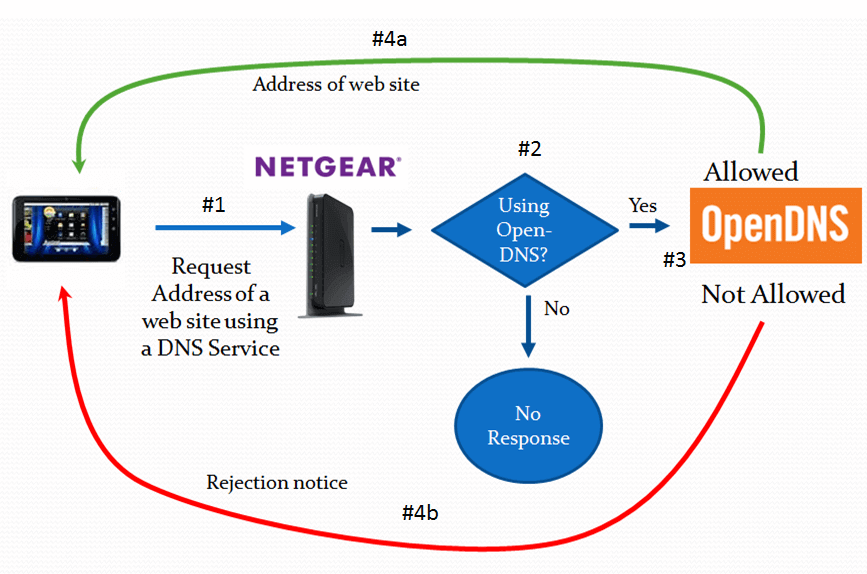
When a device uses OpenDNS, domain-name requests are checked against OpenDNS filtering rules before the browser is directed to a website. If a domain falls into a blocked category or is manually blocked, OpenDNS can prevent that DNS request from resolving normally.
Important: DNS filtering only works when the device is actually using the filtered DNS service. It is one layer of protection, not a guarantee that every type of explicit content inside every website or app will be removed.
Part 2: Why Some Porn Sites May Still Be Unblocked
If parents are seeing unblocked porn sites after setting up OpenDNS, one of the following explanations is more likely than “OpenDNS does not block porn.”
1. A New or Misclassified Domain
Adult websites can move to new domains, mirrors, or subdomains. A newly created domain may not yet be classified correctly. OpenDNS maintains a domain-classification system, but no classification database can identify every new domain instantly.
2. The Device Is Not Using OpenDNS
A router may be configured for OpenDNS while a device, browser, app, or network profile uses another DNS resolver. When that happens, the OpenDNS filtering policy is not being consulted for those requests.
3. The Child Is No Longer on the Filtered Home Network
OpenDNS configured on a home router applies while devices use that network. If a phone switches to mobile data, another Wi-Fi network, or another connection that does not use the configured OpenDNS resolver, the home-router filtering rules no longer control that traffic.
4. A VPN or Encrypted DNS Service Changes the DNS Path
Some VPNs and encrypted-DNS configurations can send DNS requests through a resolver other than the one configured on the home router. Parents do not need to learn how to bypass filtering, but they should know that these tools can explain why a correctly configured home DNS filter appears inconsistent.
5. The Content Is Inside a Mainstream Platform
DNS filtering works at the domain level. It may block an entire domain, but it cannot always distinguish one safe page from one explicit post inside the same social, forum, or user-generated-content platform. This is why adult material inside otherwise legitimate platforms may require platform settings, search filtering, or device-level parental controls.
6. Incognito Mode Is Being Blamed for the Wrong Reason
Private or incognito browsing does not by itself switch a device away from OpenDNS. If the device is still using the same DNS resolver, DNS filtering should still apply. If filtering fails only in a particular browser, check that browser's DNS, VPN, privacy, or network settings instead of assuming incognito mode is the cause.
Part 3: How to Fix OpenDNS Filtering Problems
Step 1. Confirm Which OpenDNS Service You Are Using
If you want a simple adult-content filter, verify that the device or router is using the current FamilyShield addresses. If you use OpenDNS Home, sign in and confirm that the appropriate adult-content categories are enabled.
Step 2. Confirm OpenDNS Is Actually Active
Use the official OpenDNS setup test after configuration. If the test does not recognize OpenDNS, fix the DNS configuration before changing content-filtering settings.
Step 3. Check Every Connection the Child Uses
Review the child's phone, tablet, computer, and other browsers. A router-level rule cannot protect a device after it moves to another network unless another filtering layer is also present.
Step 4. Add Specific Domains When Classification Is Delayed
With OpenDNS Home, parents can add specific domains to their filtering settings. This is useful when one newly identified adult domain is not yet being categorized the way you expect.
Step 5. Use Category Filtering Instead of Chasing a “Porn Sites List”
Trying to maintain a static list of every unblocked porn website is not practical. Domains change too quickly. Use adult-content categories as the default layer, then add exceptions for individual domains that need special handling.
Step 6. Add Device-Level Controls for Apps and Browsers
If the child uses mobile data, multiple networks, social apps, or browsers with their own privacy features, combine DNS filtering with device-level parental controls. That provides another policy layer even when the home network is not the only connection being used.
Part 4: Add Device-Level Filtering with FamiSafe
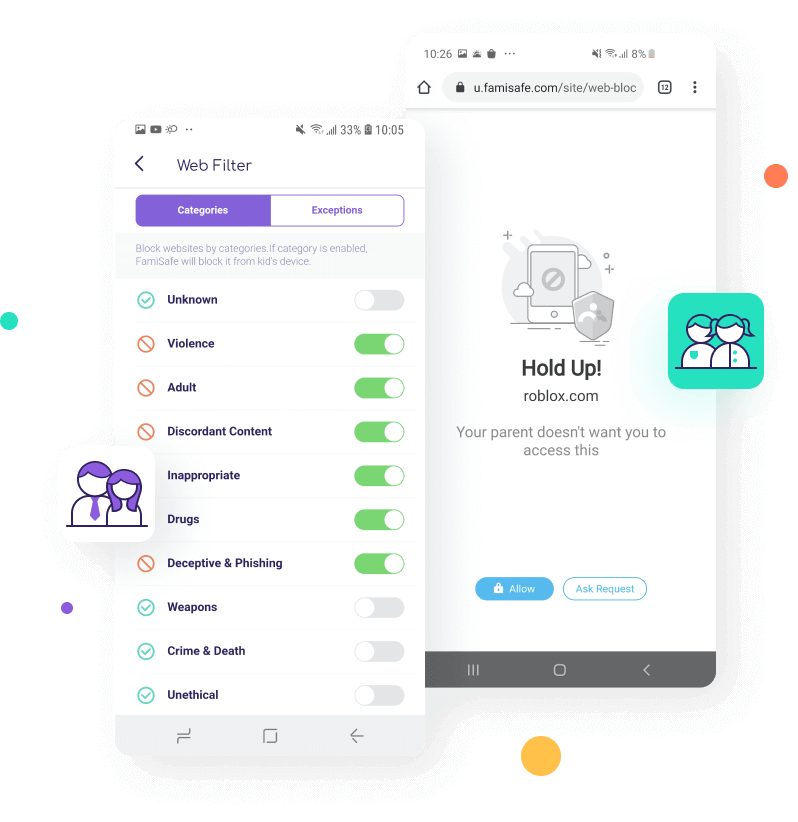
FamiSafe Web Filter works at the device-management layer rather than replacing OpenDNS at the DNS layer. Parents can use both together.
Web Filter
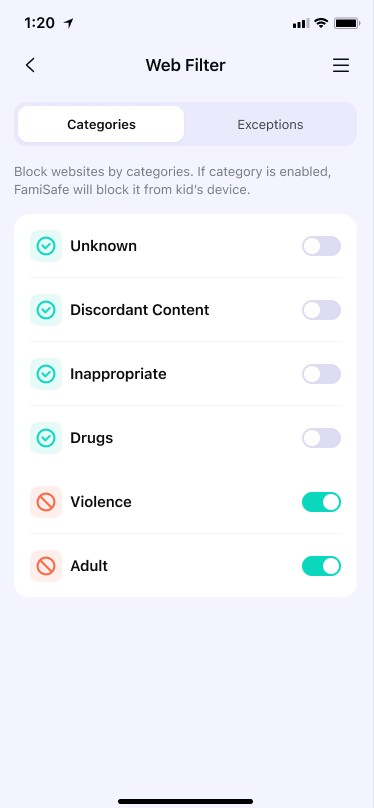
FamiSafe's current user guide states that Web Filter includes more than 10 website categories, including Adult, Violence, Drugs, and Weapons. Parents can enable a category filter and also add individual websites as blocked or allowed Exceptions.
Browser History
Browser History lets parents review visited websites on supported devices and turn a visited domain into a blocked or allowed exception. This is useful when a specific adult site appears that was not already covered by a category filter.
Safe Search
FamiSafe Safe Search can filter explicit search results on supported browsers and search engines. It should be treated as an additional layer, not as a substitute for Web Filter or DNS filtering.
Suspicious Content Detection
On supported devices and apps, FamiSafe can surface risky or inappropriate text signals and custom keywords. This can complement website filtering when the concern is explicit content appearing through social or messaging apps rather than through a browser.

App Rules
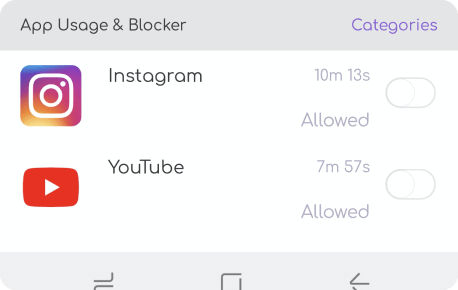
If the issue is an app rather than a website, App Rules can limit or block app access on supported devices. This is useful because DNS website filtering alone does not provide the same type of app-management control.
Compatibility note: available FamiSafe features vary by operating system and device configuration. Check the latest FamiSafe user guide before relying on a specific control.
Conclusion
If porn is still unblocked after you configure OpenDNS, do not assume the service has no adult filter. In 2026, FamilyShield is still preconfigured to block adult content, while OpenDNS Home still provides customizable category filtering. The more useful troubleshooting question is whether the domain is classified correctly and whether the child's device is actually using the filtered DNS path.
For families with phones, multiple networks, apps, and several browsers, a layered setup is stronger than relying on one network filter. OpenDNS can provide the DNS layer, while device-level tools such as FamiSafe can add website categories, URL exceptions, browser visibility, search filtering, and app controls on supported devices.
Frequently Asked Questions
Q1. Does OpenDNS block porn sites?
Yes. OpenDNS FamilyShield is preconfigured to block adult content, while OpenDNS Home offers customizable web-content filtering across more than 50 categories. Filtering only works when the device's DNS requests are actually using the configured OpenDNS service.
Q2. Why are some porn sites not blocked by OpenDNS?
Possible reasons include a new or misclassified domain, a device using another DNS resolver, traffic using mobile data instead of the filtered home network, a VPN or encrypted DNS service, or incorrect OpenDNS network settings.
Q3. Does incognito mode bypass OpenDNS?
Incognito or private browsing by itself does not change the DNS resolver used by the device. If OpenDNS is correctly configured and the browser is still using that DNS path, DNS filtering should still apply. Other network or DNS settings can change that behavior.
Q4. What is the difference between OpenDNS FamilyShield and OpenDNS Home?
FamilyShield is a free OpenDNS option that is preconfigured to block adult content. OpenDNS Home is also free but allows users to customize content filtering and choose from more than 50 filtering categories.
Q5. Can OpenDNS block adult content on mobile data?
A router-level OpenDNS setup protects devices while they use the configured home network. If a phone switches to mobile data or another network, that router's DNS settings no longer control the connection unless filtering is also configured on the device or through another parental-control layer.
Q6. How can parents block adult sites that OpenDNS misses?
First verify that OpenDNS is active and that adult-content filtering is enabled. Then add specific domains to a block list if needed. For another layer, FamiSafe Web Filter can block website categories and add specific sites as blocked or allowed exceptions on supported devices.
Q7. Can FamiSafe replace OpenDNS?
They work at different layers. OpenDNS is a DNS-level filtering service, while FamiSafe provides device-level parental controls such as Web Filter, Browser History, Safe Search, and App Rules on supported devices. Families can use them together rather than treating one as a complete replacement for the other.
Thomas Jones
chief Editor